
Virtual Assistants For Optometry Practices
Staff the front desk and back-office of your optometry practice with fully vetted, HIPAA-aligned virtual professionals at a fraction of the cost.


Response
We place certified virtual team members as an extension of your practice.

Patient Experience
Keep clinical staff focused on care while admin work runs smoothly in the background.

by Role
Add virtual staff based on workflow demand, not headcount limitations.

Processes
Virtual staff work inside your systems with role-based access and defined workflows.

Fully-Trained Virtual Healthcare Staff For Your Optometry Office
Running a busy optometry office means balancing a steady flow of patients with the front desk and back-office workflows that keep every visit on track. As your patient roster grows, so do the daily touchpoints, calls and messages, appointment scheduling and recalls, insurance verification, billing follow-up, and the administrative details that support a smooth patient experience. Even with a strong team in place, growth often requires more consistent coverage and cleaner follow-through across these workflows. Expanding your optometry practice should enhance patient care and service, not pull attention away from it.
Virtual staffing helps your optometry office stay responsive and organized while your on-site team focuses on in-person care and a welcoming patient experience. Staffing For Doctors provides trained virtual healthcare staff who can support optometry-specific workflows like front desk coverage, appointment scheduling, recall outreach, patient coordination, insurance and billing processes, documentation support, and referral and records tracking. Roles are defined around task ownership and integrated into your existing systems with role-based access and HIPAA-aligned processes, so patient information is handled responsibly from day one. As demand increases, you can scale support by role and by need without disrupting operations, which helps your office stay efficient, consistent, and patient-friendly.
Virtual staffing gives your optometry practice the flexibility to grow on your terms. You can add coverage where it matters most, strengthen patient communication, and keep scheduling running smoothly without taking on the overhead of additional in-office hires. When you are ready to improve day-to-day operations and scale affordably, schedule a consultation with Staffing For Doctors to see how virtual staffing can support your optometry office. Call us now at (833) 503-1289.

The Best Virtual Assistant Roles for Optometry Practices
As an optometry practice grows, the front desk and back-office workload often increases faster than the time available to manage it. More appointment requests, more recalls, more insurance questions, and more documentation and records needs can pull your team into constant task switching throughout the day. At Staffing For Doctors, we know the best virtual optometry staffing roles are process-driven, repeatable, and tied to outcomes your office can measure, like faster response times, smoother scheduling, cleaner insurance workflows, and more consistent follow-through. The roles below work especially well for virtual staffing because they strengthen patient communication and office efficiency without disrupting in-person care.

Virtual Optometry Front Desk Assistant
Virtual Front Desk Support for Optometry Calls, Scheduling, and Patient Messages
Responsiveness is a major advantage for optometry practices, especially for new patient inquiries and time-sensitive scheduling requests. A virtual front desk assistant helps your office answer questions quickly, guide patients to the next step, and keep conversations organized. Over time, this consistency supports a smoother schedule and a more professional patient experience.Optometry Call Handling and Patient Triage That Protects In-Office Flow
Clear routing rules help ensure the right requests reach the right person. A virtual assistant can handle routine scheduling and administrative questions while escalating clinical concerns or urgent issues to your team. This keeps patient communication moving without interrupting the clinic rhythm.Documentation Standards for Optometry Patient Conversations
Consistent notes reduce repeated conversations and missed details. Virtual staff can document outcomes, next steps, and patient requests inside your practice systems. This improves follow-through and supports cleaner handoffs throughout the day.Appointment Confirmations, Rescheduling, and Recall Support for Optometry Practices
Scheduling consistency keeps an optometry calendar running smoothly. A virtual front desk assistant can manage confirmations, reminders, and rescheduling requests using your standards. This helps protect appointment availability and reduce day-of disruptions.Optometry Waitlist Management and Cancellation Backfill
A structured waitlist helps fill openings quickly and keep the schedule productive. Patients looking for earlier appointments can be contacted and confirmed efficiently. This supports better schedule utilization without increasing stress on your team.New Patient Scheduling and Pre-Visit Instructions
New patient scheduling works best when patients receive clear guidance. Virtual support can communicate basic prep steps, forms expectations, and timing details. This helps the first visit feel organized and patient-friendly.Virtual Optometry Administrative Assistant
Optometry Office Administrative Support for Daily Operations
As patient volume increases, administrative tasks multiply across departments. A virtual admin assistant helps by organizing tasks, tracking routine updates, and keeping information accessible. This supports smoother operations and reduces bottlenecks.Forms, Records, and Document Organization for Optometry Practices
This role can manage document intake, organize forms, and help maintain records according to your office standards. It can also prepare packets, handle routine requests, and keep administrative queues moving. Cleaner organization supports faster execution.Inbox Triage and Internal Task Tracking for Optometry Teams
Inbox volume and internal requests can pile up quickly. A virtual admin assistant can triage messages, route tasks, and track follow-up items so nothing falls through the cracks. This improves accountability without adding friction.Scalable Administrative Workflows for Growing Optometry Practices
Administrative support scales well because responsibilities can be layered as your needs evolve. You can start with task execution and expand into coordination and reporting. This keeps growth organized instead of disruptive.Standardize Routine Processes for Consistent Execution
Consistency reduces rework and improves day-to-day flow. A virtual admin assistant can help implement repeatable processes and checklists. That helps the practice run smoothly as volume increases.Improve Office Manager Bandwidth for Higher-Value Work
When routine admin tasks are owned by a dedicated role, office managers can focus on improving systems. This supports stronger operations and more strategic practice growth. The team benefits from clearer priorities.Virtual Optometry Billing and Insurance Assistant
Optometry Insurance Verification and Eligibility Support
Insurance questions often require quick, accurate handling. Virtual support helps verify eligibility, document coverage details, and keep your workflow moving before appointments. This reduces surprises and improves scheduling confidence.Support Medical and Vision Plan Workflows in Optometry Practices
Optometry practices often handle both medical and vision-related billing pathways. A dedicated billing and insurance assistant helps keep requirements organized and documentation consistent. This improves accuracy and reduces rework.Improve Documentation Quality for Cleaner Insurance Processing
Billing runs smoother when documentation is complete and organized. Virtual staff can track missing details and maintain clear notes. This supports stronger workflow coordination between teams.Optometry Billing Support for Claims Follow-Up and Patient Statements
Billing consistency protects cash flow and reduces administrative friction. Virtual billing support helps maintain follow-up cadence and keep tasks moving through your established process. This helps your team stay organized as volume increases.Claims Follow-Up and Status Checks for Optometry Billing
Routine follow-up tasks can be handled consistently by a virtual billing assistant. This role can track claim status, document progress, and flag exceptions that need escalation. Consistency reduces backlog and improves visibility.Patient Billing Communication and Balance Follow-Up
Patient billing clarity improves when communication is consistent. Virtual support can help with routine patient balance outreach and documentation within your standards. This supports a smoother billing experience for patients.Virtual Optometry Scribe
Optometry Documentation Support for Chart Notes and Exam Records
Documentation consistency supports continuity across the patient journey. A virtual scribe can align chart notes with your templates and preferred structure. This creates cleaner records that are easier to review later.Chart Note Creation Using Optometry Templates and Standards
A scribe supports documentation using your established format and expectations. Notes can be organized for clarity and completeness. Over time, this helps reduce variability across providers.Follow-Up Item Tracking and Clear Next-Step Documentation
Documentation works best when next steps are clear. A scribe can help organize follow-up items, testing steps, and patient instructions in the chart. This supports smoother handoffs to staff and better patient clarity.Optometry Scribe Workflow Alignment and Provider Review Process
Scribing succeeds when expectations are defined and review steps are clear. The practice sets a review cadence so providers approve documentation efficiently. Once established, documentation support becomes a steady extension of your clinical workflow.Maintain Documentation Consistency Without Slowing Down Visits
A structured process keeps scribing efficient. Providers stay focused on the exam while documentation is completed with consistency. This helps the day run smoother.Support Better Continuity Across Patient Visits
Clean documentation helps teams provide more consistent care across visits. Notes are easier to reference and less likely to require reconstruction later. This supports a more organized patient experience.Virtual Clinical Documentation Support for Provider Efficiency
A virtual scribe helps providers stay focused on the patient while documentation is completed consistently. Notes follow your templates and preferred structure. This supports a cleaner clinical workflow.Visit Documentation and Chart Note Assistance Done By Virtual Medical Office Staff
This role supports chart note creation using your templates and documentation standards. It can organize follow-up items so next steps are clear for the clinical team and the patient. Consistency improves record usability over time.Provider Review Cadence and Documentation Workflow Alignment
Scribing works best when expectations are defined, including what is documented, where it goes, and who approves it. The practice sets a review cadence so providers stay confident notes reflect clinical intent. Once that process is set, documentation support becomes a steady extension of care delivery.HIPAA-Aligned Documentation Practices With Role-Based Access For Virtual Staff
Clinical documentation involves sensitive information and requires consistent standards. Virtual scribes are onboarded with role-based access and clear documentation expectations. This supports responsible handling of patient information.Standard Templates and Structured Note Formatting
Structured templates improve clarity and reduce missing information. Virtual scribes can align notes with your established format. This supports consistent documentation quality.Clear Access Controls for Clinical Documentation Support
Permissions are limited based on role needs. This reduces risk while still allowing the scribe to support documentation workflows. Role-based access supports secure integration.Virtual Optometry Patient Care Coordinator
Optometry Patient Follow-Up, Recalls, and Ongoing Care Coordination
Follow-up supports long-term patient relationships and helps keep the schedule full. A virtual coordinator can manage recall outreach, appointment reminders, and next-step communication using your standards. This keeps patients engaged and informed.Recall Outreach and Reactivation for Optometry Practices
Recalls are an operational growth lever when managed consistently. Virtual support helps maintain cadence and keep recall lists from stalling. This supports schedule stability over time.Patient Communication for Contact Lens Follow-Up and Next Steps
Optometry practices often have recurring follow-up needs. A coordinator can support patient communication around next steps, reminders, and routine outreach within your scripts. This helps patients feel guided and supported.Improve Patient Experience With Consistent Communication
Patient experience is shaped by clarity and responsiveness. A coordinator helps ensure patients receive timely updates and clear next steps. This builds trust and supports repeat visits.Reduce Patient Friction With Clear Expectations and Guidance
When patients know what to expect, the practice feels easier to work with. Coordinators help reinforce timelines and instructions. This improves satisfaction and follow-through.Close Communication Loops With Documented Outcomes
Documented outcomes help teams stay aligned. This reduces repeated conversations and missed tasks. Patients experience a practice that feels organized and attentive.Procedure Scheduling and Pre-Op Coordination for Medical Practices
Procedure scheduling involves more than selecting a time slot. A virtual scheduler tracks steps, communicates requirements, and supports readiness checks. This creates a smoother process for patients and staff.Pre-Op Instructions and Patient Communication Support
Patients appreciate clear guidance and timely reminders. This role can ensure instructions are communicated consistently and questions are routed correctly. Consistent communication improves preparedness.Coordination of Forms, Clearances, and Scheduling Requirements
Schedulers can track required documents and readiness steps based on your workflow. Clear tracking prevents last-minute confusion. The result is a more organized procedure pipeline.Reduce Procedure Schedule Disruptions With Readiness Checks
Readiness checks help protect high-value calendar time. A virtual scheduler can confirm required steps and reinforce expectations ahead of time. This supports fewer day-of surprises.Confirmations and Timeline Tracking for Procedure Appointments
Consistent confirmations help ensure patients and teams stay aligned. Timeline tracking supports better preparation. This improves scheduling reliability.Escalation Rules for Clinical Questions and Urgent Changes
Not every request belongs at the front desk. Clear escalation rules ensure clinical questions and urgent changes reach the right team member quickly. This protects clinical time while supporting patient confidence.Virtual Optometry Referral and Records Coordinator
Optometry Referral Tracking and Partner Provider Communication
Referrals and co-management workflows require clear tracking and consistent outreach. A coordinator can manage referral intake, documentation handling, and communication based on your process. This helps referrals move smoothly without becoming a hidden bottleneck.Referral Intake, Documentation Requests, and Status Updates
This role can track required documents, request missing items, and keep status notes updated. Patients benefit from clearer expectations and fewer delays. Teams benefit from better visibility into what is pending.Close the Loop on Referral Outcomes and Care Continuity
A referral is not complete until outcomes are confirmed and documented. A coordinator ensures closure steps happen consistently. This supports better continuity and cleaner records.Optometry Records Requests and Release Coordination
Records and documentation requests require organization and accuracy. A coordinator can help manage routine records requests and ensure proper documentation handling within your standards. This keeps the process efficient and predictable.Improve Records Turnaround and Reduce Follow-Up Cleanup
Organized tracking reduces the need to recheck status repeatedly. Requests move through a defined process. This gives your office more time back.Support Patient Confidence With Clear Records Communication
Patients appreciate knowing what is happening and what is needed. Consistent communication helps reduce confusion. This supports a smoother overall experience.Virtual Assistants Give Your Optometry Practice More Room to Grow
Growth in an optometry practice is exciting because it reflects strong patient demand, a fuller schedule, and a stronger presence in your community. It also increases the operational workload that supports each visit, from scheduling and recalls to insurance workflows, records, and patient communication. Virtual staffing creates breathing room by strengthening the office workflows that scale first, so your team can keep service consistent as volume rises. The benefits below show how virtual optometry support helps you grow with more control, more flexibility, and a better experience for patients and staff.
Reduce Optometry Staffing Costs With Virtual Support
Save Up to 60% Compared to Hiring In-Office Staff
Cost efficiency gives optometry practices more options. You can add the support you need for scheduling, recalls, patient communication, and insurance workflows without committing to additional on-site headcount. That flexibility helps you scale sooner and maintain steadier operations as patient volume increases.Protect Profitability While Expanding Patient Access
Lower staffing costs can help you expand hours, support more appointments, or increase responsiveness without increasing overhead at the same rate. This supports growth that stays financially sustainable. It also allows your practice to improve service and systems without overextending.Reinvest Savings Into Patient Experience and Practice Growth
When staffing costs are controlled, you can reinvest into upgrades that patients notice. Practices often prioritize better patient tools, improved follow-up systems, or marketing that drives consistent demand. Virtual staffing helps you fund growth while keeping operations stable.
Improve Patient and Team Retention With Consistent Optometry Support
Keep Patients and Staff Longer With Reliable Workflow Ownership
When one person owns key processes like recalls, reminders, and patient updates, the practice feels more dependable. Patients experience fewer dropped threads and clearer next steps. Staff benefit from fewer last-minute scrambles and a calmer daily rhythm.Strengthen Recall and Reactivation Consistency
Recalls support both patient care and long-term growth, especially when outreach is handled consistently. Virtual support helps practices maintain cadence so recall lists do not stall. This supports patient continuity and a more reliable schedule.Reduce Operational Disruptions That Wear Teams Down
A steadier workflow reduces the need for constant task switching. When routine tasks are owned and tracked, teams spend less time catching up. That improves morale and supports long-term retention
Grow an Optometry Practice Faster With Dedicated Virtual Assistants
Dedicated Virtual Optometry Staff Focused on Your Office
Dedicated staffing supports stronger day-to-day execution. Your virtual assistant learns your practice preferences, scripts, and workflow handoffs, which reduces friction over time. This helps your optometry office run more smoothly as you scale.Maintain Consistent Patient Communication Standards
Patients appreciate clear answers and predictable next steps. Dedicated support helps keep your tone and messaging consistent across calls, messages, and follow-up. That consistency strengthens trust and improves the patient experience.Build a Scalable Support System by Role
Dedicated staffing makes it easier to expand support by workflow rather than stretching one person across everything. You can add roles that complement each other, like front desk support plus recalls or insurance support. This creates a staffing model built for growth.
Streamline Optometry Office Workflows With Virtual Staffing
Free Your Optometry Team From Administrative Overload
Virtual support helps reduce the administrative load that grows alongside patient volume. When routine tasks are handled consistently, on-site teams can focus on in-person service and clinical flow. This improves efficiency without changing how care is delivered.Reduce Task Switching With Cleaner Handoffs
Clear handoffs help teams move faster and avoid repeated conversations. Virtual staff can document outcomes and next steps inside your systems. This supports better coordination across the office.Improve Office Manager Bandwidth for Higher-Value Operations
When administrative workflows are owned and organized, office managers gain time to improve systems. That may include refining recall processes, tightening scheduling standards, or improving patient communication. Virtual support helps create that space.
Expand Optometry Practice Capacity Without Added Overhead
Fully Remote Optometry Staff Integrated Into Your Existing Systems
Virtual staff work within the tools your practice already uses, following your standards and workflow rules. This keeps operations consistent while expanding coverage. It also makes growth easier because the practice is not forced to redesign processes.Scale Support Without Office Buildouts or Extra Workstations
Remote staffing allows you to expand support without changing your office layout. This is especially helpful for practices that want to grow before investing in a larger space. You gain capacity while keeping overhead controlled.Keep the Office Environment Calm and Patient-Friendly
A less crowded administrative environment often improves the feel of the practice. On-site teams can focus on hospitality and patient-facing service. Patients experience smoother visits with less operational noise.
Cut Recruiting Costs With Virtual Optometry Staffing
Avoid Recruiter Fees and Reduce Turnover-Related Hiring Costs
A more efficient hiring model reduces the cost of adding qualified support. Instead of paying placement fees, practices can focus on selecting the right fit and integrating quickly into established workflows. This supports more consistent operations over time.Fill Roles Faster With a Vetted Candidate Pipeline
A steady candidate pipeline helps practices add support when workload increases. Faster hiring supports better continuity in patient communication and scheduling. That speed helps protect service quality during growth phases.Build a Repeatable Hiring Process for Future Roles
A repeatable hiring approach makes scaling easier. Once the process is established, your practice can add complementary roles without starting from scratch. This supports long-term operational planning.
Improve Patient Responsiveness With Virtual Optometry Support
Faster Response Times and Clearer Patient Communication
Timely communication helps patients schedule confidently and stay engaged in care. Virtual staff ensure requests are acknowledged quickly and routed correctly based on your workflow. This makes the practice feel more accessible and organized.Improve New Patient Scheduling Momentum
New patient inquiries often move quickly, and responsiveness matters. Virtual support helps keep inquiries from stalling by guiding patients to the next step and confirming details promptly. This supports a fuller schedule.Strengthen Follow-Through Across Recalls and Next Steps
Follow-through keeps patients connected to the practice after the visit. Virtual support helps maintain cadence for reminders, recalls, and routine updates. This supports patient satisfaction and long-term growth.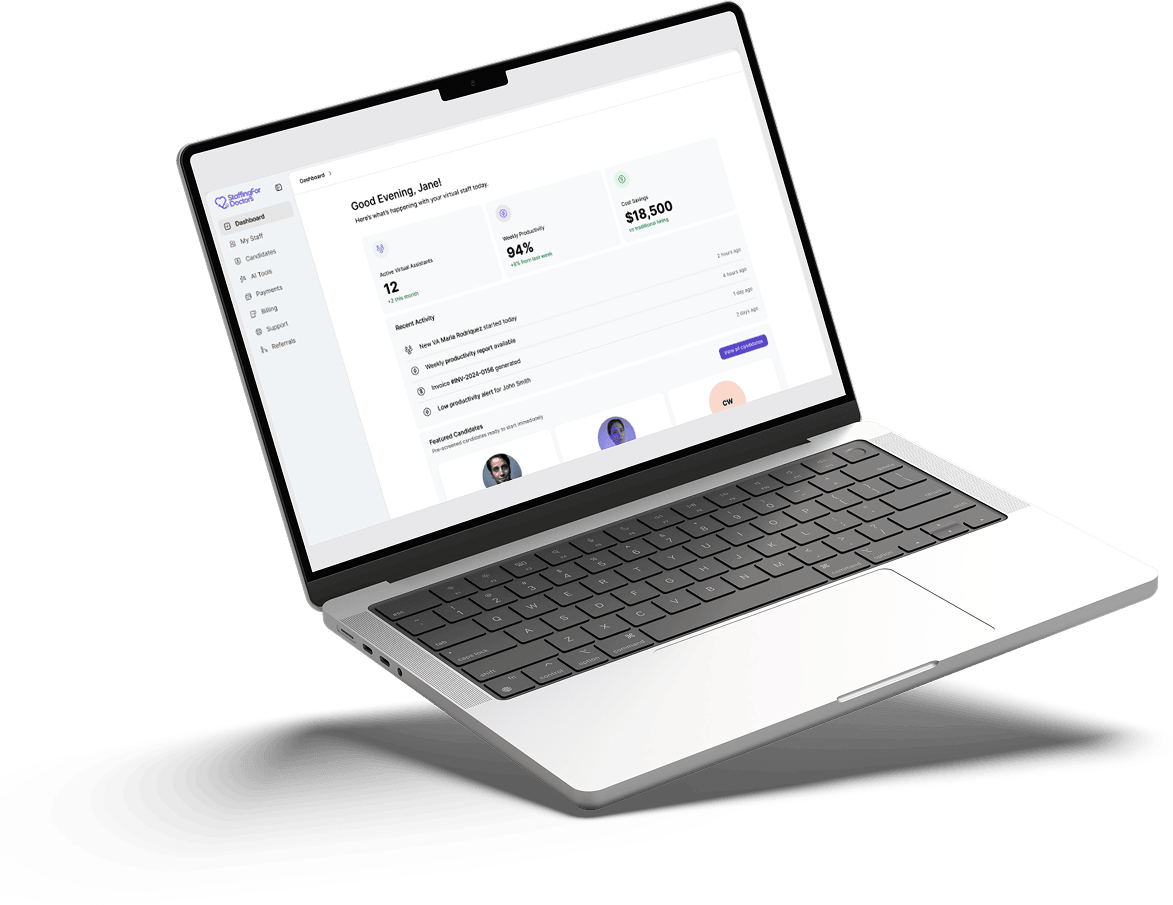



Manage Your Virtual Optometry Staff Stress-Free With Our Dashboard
As optometry practices and clinics grow, visibility and control become just as important as staffing itself. The Staffing For Doctors dashboard gives optometrists, practice managers, and office administrators a centralized place to manage virtual optometry staff, candidate activity, and day-to-day workflows without adding complexity. Instead of juggling emails, spreadsheets, and disconnected tools, your team can keep staffing operations organized in one system. This supports consistent patient communication, smoother scheduling and recalls, and stronger back-office execution as patient volume increases.
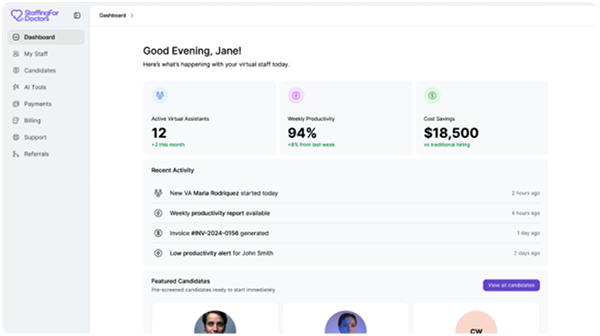
My Staff:
Manage Active Virtual Optometry Staff and Role Coverage
Match Team Members to Specific Optometry Responsibilities
Each virtual team member can be tied to defined duties, such as scheduling and reschedules, recall and reactivation outreach, patient text and phone support, insurance and eligibility coordination, billing assistance, documentation support, and referral, records, and request tracking. With responsibilities clearly mapped, office managers can route work quickly and maintain a consistent tone across patient communication, even when multiple roles touch the same patient timeline.Improve Patient Follow-Through With Clear Ownership
When the owner of each workflow is obvious, patients get answers faster and next steps are less likely to stall. Your team spends less time reassigning tasks or searching for status updates. That creates a smoother daily operating cadence, with fewer loose ends and more reliable follow-up. Candidates:
Recruit and Interview Virtual Optometry Staff Faster
Streamlined Candidate Pipeline for Virtual Optometry Staffing
Review profiles, compare candidates side by side, and progress to interviews through a clear, structured flow. This makes it easier to assess fit for roles like virtual front desk coverage, billing and insurance support, patient care coordination, and referral, records, and request handling. A more organized pipeline supports faster decisions with fewer delays.Evaluate Fit for Optometry Workflow Needs and Patient Communication
Optometry offices rely on consistent patient messaging and steady follow-through. Candidate visibility makes it easier to prioritize experience with scheduling and reschedules, recall outreach, insurance coordination, and patient communications. That alignment helps virtual team members follow your standards from day one. AI Tools:
Improve Optometry Practice Efficiency and Workflow Consistency
Support Optometry Patient Communication and Repeatable Office Workflows
AI tools can help reinforce scripts, templates, and workflow standards across roles. That makes it easier for virtual staff to stay aligned with your tone and patient experience standards. Consistency is especially valuable when multiple team members support the same patient journey.Standardize Scheduling, Recall, and Follow-Up Messaging
Consistent messaging helps patients understand next steps and arrive prepared. Templates reinforce clarity across confirmations, reminders, and recall outreach. This supports a more predictable experience. Payments:
Track Virtual Optometry Staffing Costs Predictably
Simplified Payments for Virtual Optometry Staffing Services
Managing payments through a centralized system limits unnecessary back-and-forth. Charges are easy to review, and payments can be handled without tracking down invoices across email threads. This keeps financial tasks structured and easier to maintain.Reduce Administrative Friction in Optometry Staffing Management
More efficient payment workflows cut down on internal coordination and follow-ups. Staff can stay focused on patient-facing priorities instead of staffing-related paperwork. Over time, this supports smoother management and more predictable operations. Billing:
Support Optometry Billing and Insurance Workflows With Better Visibility
Organized Oversight for Optometry Billing and Insurance Coordination
A centralized view of billing work helps office managers stay informed without hovering over every task. It becomes easier to spot issues early, flag exceptions, and keep follow-ups tied to the right claim or patient account. That level of oversight supports consistency across documentation-heavy responsibilities.Improve Billing Consistency With Trackable Workflow Progress
When workflow status is visible, teams can maintain a steady pace and avoid last-minute pileups. Trackable progress helps reduce backlog, keeps follow-up from getting lost, and clarifies what needs attention next. This supports smoother execution throughout the day. Support:
Get Help With Virtual Optometry Staffing and Onboarding
Centralized Support for Optometry Practice Staffing Needs
Support is easier to use when it is built into the same workflow as your staffing management. Instead of slow back-and-forth, you have a direct path to guidance, especially when roles shift or coverage needs change. Faster resolution keeps operations more predictable.Resolve Staffing Questions Without Slowing Down Patient Service
When questions come up midstream, quick support helps the team stay productive instead of pausing workflows. This is especially useful during staffing changes, new role ramp-ups, or process updates. Keeping work moving protects scheduling accuracy and keeps patient communication consistent. Referrals:
Track Optometry Referrals and Records for Better Follow-Through
Referral Tracking for Optometry Practices and Care Continuity
Keeping referral activity in one centralized view helps teams stay coordinated and reduces reliance on memory or scattered notes. You can track where each referral stands, who it was sent to, and what has been completed. That structure supports better continuity throughout the patient journey.Improve Referral Coordination With Clear Status Updates
Referral workflows move faster when status changes are obvious and simple to maintain. Clear tracking reduces missed handoffs, duplicate follow-ups, and uncertainty around next steps. Patients benefit from clearer expectations and a more guided experience.
Staffing For Doctors Helps Your Optometry Practice Recruit Top Virtual Employees
Staffing For Doctors connects optometry practices with qualified virtual professionals who are trained to support the workflows that keep your office running smoothly. From front desk coverage and patient coordination to insurance, billing, documentation, and records management, each role is matched to your systems and expectations. With structured screening and role-based preparation, virtual staff integrate into your existing operations quickly, helping your practice maintain consistency, responsiveness, and a high standard of patient service.
As your optometry practice grows, virtual staffing gives you the flexibility to expand support without increasing physical overhead or slowing down internal processes. You gain access to a broader talent pool, predictable staffing costs, and dependable coverage that can scale by role and by demand. With nationwide coverage, Staffing For Doctors supports optometry offices and clinics across the country, whether you operate a single location or manage multiple practices. The result is a staffing model that supports growth, protects patient experience, and strengthens daily operations. If you are ready to recruit top virtual employees and build a more scalable optometry practice, schedule a consultation with Staffing For Doctors today. Call (833) 503-1289.
Get reliable, scalable support that transforms your practice operations and patient experience.

Save up to 60% compared to hiring in-office staff.

Keep your team and patients longer with consistent, reliable support.

A virtual assistant fully focused on your practice—no shared staffing.

Fully remote staff integrated into your existing systems.